Shovel Talk: Why One Chicago Winter Can Bond You to a Block Faster Than a Decade Anywhere Else
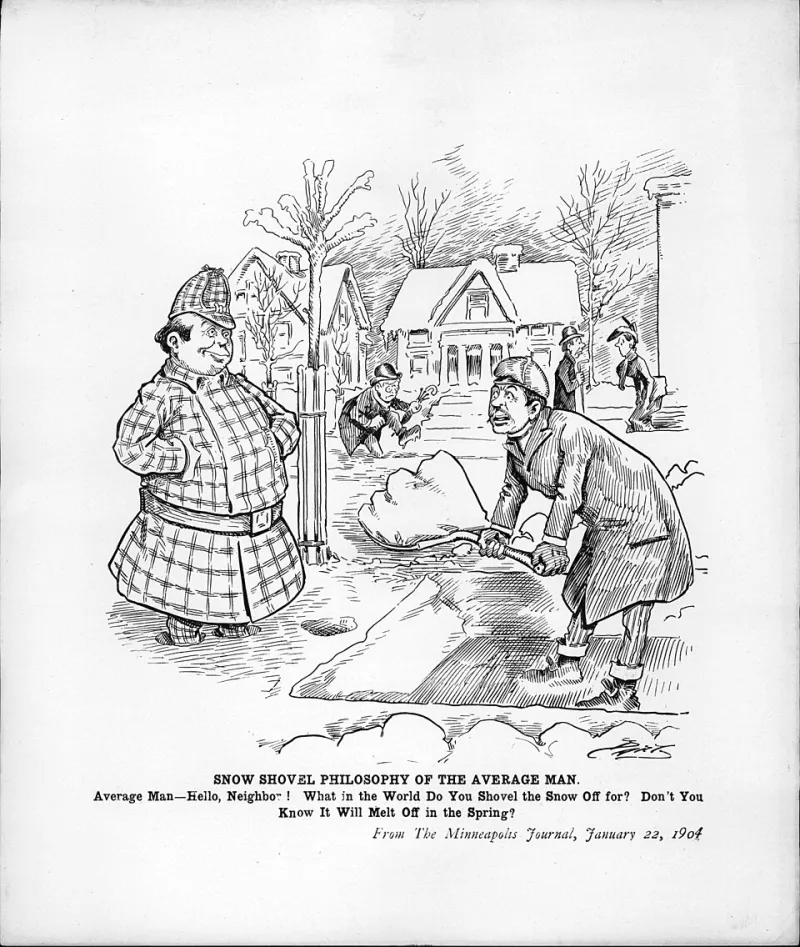
Photo: Bartholomew, Charles Lewis 'Bart', 1869-1949, Public domain, via Wikimedia Commons
There's a moment that happens on Chicago sidewalks every January. A newcomer — maybe someone who moved here from Dallas for a job, maybe a remote worker who picked Logan Square off a listicle — is standing on their block at 7 a.m., staring at eighteen inches of snow burying their car. They own a shovel they bought in a panic the night before. They have no idea what they're doing.
And then a neighbor appears. Maybe with a second shovel. Maybe with a snowblower and an opinion about the alderman. And within twenty minutes, the stranger knows three names on the block, which house has the good radiator, and exactly which bar is still serving food when the plows haven't come through.
Ask around and you'll hear it over and over: Chicagoans believe — genuinely, almost superstitiously — that surviving winter together is the fastest friendship engine in America.
The Weather Did the Introduction
Maria Delgado has lived on the Northwest Side for eleven years, and her block organizes an informal shoveling rotation that has never once been written down. "When it snows hard, nobody texts," she says, leaning on a shovel outside her Portage Park two-flat. "You just hear the scrapers. You put your boots on. Somebody's mom made too much tamales, and that's how the whole thing starts."
Delgado's crew has cleared sidewalks for elderly neighbors since before anyone called it a mutual aid network. But she's quick to point out that it isn't charity — it's choreography. "You learn who's up early, who's got a bad knee, whose kid will do anything for five dollars. That's ten years of knowing somebody, compressed into one storm."
Armchair sociologists (and at least one actual meteorologist we cornered at a Midwest climate conference) have a term-adjacent explanation: shared adversity compresses social timelines. Psychologists call it "bonding through common threat." Chicagoans call it "the polar vortex party," and yes, those were real — the 2019 vortex produced a small genre of viral photos featuring neighbors in hot tubs and pajamas, drinking wine in negative-twenty-degree air because their pipes froze and their cars died and the only sane option was to make it funny together.
What Sun Belt Transplants Know
Ask people who moved here from warmer climates, and the pattern gets almost eerie.
"In Phoenix, I knew my neighbors' cars," says Jalen Whitfield, who relocated to Chicago in 2021 and now lives in Avondale. "Three years here, I know their kids' names, their dog, their landlord drama, and who to call when my basement floods. One January did more than six years of Arizona waves-from-the-driveway."
Whitfield's theory is that cold weather removes the performance layer. "In a warm place, you can stay surface-level forever. Here, the weather forces the issue. Somebody's stuck. Somebody's walkway needs clearing. Somebody's offering you coffee because it's nine degrees and you look like you're dying. You skip small talk because small talk is physically dangerous."
There's something to that. Chicago's winter creates what researchers might call high-frequency, low-stakes interdependence: hundreds of tiny moments where you either help or you don't. And in a city that prides itself on being the City of Big Shoulders, the social cost of not helping is real. So people shovel. They push cars out of snowbanks. They leave space at the curb after they've dug out their own spot — the famous "dibs" chairs — and somehow even that territorial ritual becomes a block-wide conversation.
Summer Does the Rest
If winter is the accelerant, summer is the proof of concept. Once you've survived a blizzard with someone, showing up to their July block party feels less like an invitation and more like a formality.
Chicago's heatwaves have their own version of this. Anyone who lived through the July stretches where the whole neighborhood decamps to the lakefront, or the alleys fill with sprinklers and folding chairs, knows the rhythm: the seasons alternate between forcing you indoors together and pouring you back outside together. Neither one lets you stay anonymous for long.
Compare that to the mild-climate default, where the weather never demands anything of you, and the neighborhood never quite demands anything either. Plenty of Sun Belt cities have porches, patios, and perfect weather. What they don't have is a January that makes the block a matter of practical survival.
How to Let the Seasons Work on You
If you're new here — or new to your block — the playbook is simple, and every long-timer we talked to agreed on the basics:
- Buy the shovel before you need it. Showing up prepared is half the social contract.
- Clear more than your own sidewalk. The couple extra feet in front of the elderly neighbor's house is where belonging actually starts.
- Say yes to the weird winter stuff. The chili night, the snow-day group text, the dibs debate. All of it is onboarding.
- Return the favor in July. Bring the popsicles. Host the grill-out. The ledger is meant to be long and never balanced.
Ten Years in One Winter
Nobody's claiming a snowstorm is a substitute for years of trust. But there's a reason Chicagoans — transplants and lifers alike — keep telling the same story: the weather here doesn't just test you. It introduces you.
So when the first real snow hits and you're out there at dawn, scraping ice off a windshield with a spatula because you haven't bought a scraper yet, look up. Someone on your block is already laughing at you, kindly, walking over with a real tool and a name you're about to learn.
That's not a cold city. That's the fastest introduction you'll ever get.