Take a Seat, Neighbor: The Front-Stoop Benches Quietly Rewiring Chicago Blocks
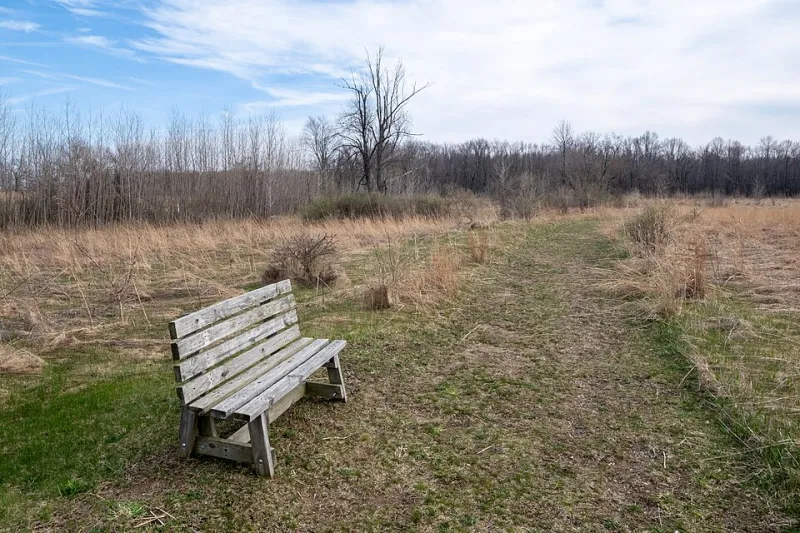
Photo: Tim Kiser, CC BY-SA 4.0, via Wikimedia Commons
There's a bench on a parkway in Albany Park that has, by its owner's rough count, hosted somewhere north of 2,000 conversations. It cost forty bucks at a big-box store. It is not attached to anything. And according to the people who live on that block, it has done more for neighborliness than any app, meeting, or mailing list ever managed.
Call it the bench theory of belonging: put one seat in a public-ish spot, and people will use it — and something about a block changes.
It Starts With Someone Willing to Look a Little Weird
The rules of the trend are loose. A resident takes an old wooden bench, a church pew, a repurposed church pew, a couple of chairs lashed to a pallet — and sets it on the parkway, that strip of city-owned grass between sidewalk and curb. No permit, no committee, no grand opening. Just an unspoken offer: you're allowed to sit here.
In Avondale, the bench outside a two-flat came with a hand-painted sign reading "FREE SITTING." In Bridgeport, a retired CTA mechanic bolted his to a concrete pad he poured himself, then added a milk crate of free seed packets. In Albany Park, the bench has a jar of chalk so kids decorate the sidewalk around it.
What follows, almost universally, is the same sequence. First, strangers sit. Then they start recognizing each other. Then they start talking. And then, somewhere around month three, the block starts acting like a block.
Three Benches, Three Micro-Economies of Trust
The Albany Park bench became a de facto message center. Neighbors leave notes under the slats — "walking dog at 6, join?" — and a running chalkboard tracks who needs what. When an elderly resident missed a few mornings of her usual bench sit, three different neighbors knocked on her door within a day. She'd had the flu. She also, she says now, had no idea anyone was keeping track.
The Bridgeport bench grew into a tool annex. A shovel appeared. Then a ladder. Then a labeled bin of screwdrivers with a laminated card: "Bring it back whenever." The block's unofficial tool library now has a waiting list of borrowed items on weekends.
The Avondale bench turned political in the gentlest way. The people who lingered there started noticing things — the broken streetlight, the speeding cut-through traffic, the fact that nobody on the block had each other's phone numbers. A group chat followed. So did a successful petition for a speed hump. The bench, one resident told us, "is where the agenda gets written before the meeting even exists."
Why a Bench Works When a Block Club Doesn't
Sociologists have a name for low-stakes public encounters like these: weak ties. They're the relationships that aren't deep but are numerous — and research consistently shows they're what makes a neighborhood feel safe and livable. A bench manufactures weak ties the way a coffee machine manufactures small talk: automatically, without anyone having to be brave.
Compare that to the traditional avenues of Chicago neighborliness — the block club meeting, the church basement, the 311 hotline — all of which require showing up on purpose. A bench requires only that you were already walking somewhere.
There's also something disarming about furniture that belongs to nobody and everybody. "People ask me whose it is," says the Albany Park bench owner. "I tell them it's theirs. You kind of watch them decide to believe me."
The Practical Guide: Starting a Bench on Your Block
Inspired? Good news: this is one of the cheapest civic interventions in existence. Here's what the bench people we met wish they'd known.
Check your parkway, not your sidewalk. The grass strip is city-owned but traditionally fair game for resident plantings and small objects. Sidewalks need to stay clear for accessibility — keep the bench back from the walking path.
Expect a conversation with the city. Rules vary by ward, and 311 complaints happen. Most bench owners report that a friendly aldermanic office will either bless it or suggest a tweak. A few have had to move a bench a few feet. None we spoke to gave up.
Weatherproof it. Chicago winters are a bench's natural enemy. Cedar and treated lumber survive; particle board does not. Consider a tarp or a seasonal rotation indoors.
Add one inviting object. A chalk jar. A little free library. A plant. One small thing signals this is tended and keeps it from reading as abandoned furniture.
Let it be imperfect. The benches that build community aren't the beautiful ones — they're the ones with a wobbly leg and a story. Perfection invites admiration. Wear invites participation.
The Bench Is the Excuse. You're the Point.
Every person we interviewed said some version of the same thing: the bench didn't do anything. People did. The bench just gave them permission and a place.
Which is, when you think about it, the whole idea of belonging in a city of nearly three million. It doesn't take a movement. It takes forty dollars, a strip of grass, and someone willing to be the first to sit down and wave.
This spring, maybe that someone is you.