Borrow a Drill, Leave With a Friend: Inside Chicago's Tool Libraries Where Fixing Things Fixes Loneliness
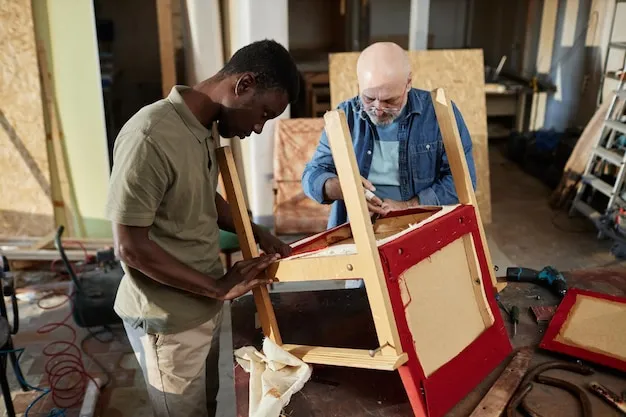
Photo: people repairing furniture together at community workshop, via img.freepik.com
There's a moment that happens at almost every tool library in Chicago. Someone walks in clutching a wobbly chair or a dead table lamp, clearly embarrassed to admit they don't own a screwdriver. Twenty minutes later, they're shoulder-to-shoulder with a retired carpenter from Portage Park, both of them hunched over the thing, arguing cheerfully about whether it's the wiring or the switch.
That's not a side effect. That's the whole point.
The Library Where You Check Out a Circular Saw
If you've never heard of a tool library, here's the pitch: it works like the branch down the street, except instead of novels, you walk out with a power drill, a wet saw, or a post-hole digger. Chicago has a handful of them now, from the long-running Chicago Tool Library in the West Loop to smaller lending setups tucked inside community organizations on the South and Northwest Sides.
The mechanics are simple. Get a membership, borrow what you need, bring it back. No garage required. No $200 trip to the big box store for a tool you'll use once. For newcomers in a city of three-point-something million people — especially renters in Albany Park or Rogers Park who don't have so much as a balcony, let alone a workbench — it's a lifeline.
But here's what the brochures don't tell you: the borrowing is almost the least interesting thing happening in these rooms.
The Ask Is the Icebreaker
Think about how friendships actually form in adulthood. It's rarely through a formal introduction. It's through repeated, low-stakes contact — the same faces, the same place, a shared task that gives you something to talk about besides the weather.
A tool library is a friendship engine disguised as a hardware checkout counter. You come in with a problem. Everyone in the building has, or has had, the same problem. And unlike a party, where small talk is the entire event, here the small talk has a subject: the thing you're fixing.
"How do I keep this from stripping the screw?" is a better opening line than anything anyone says at a rooftop happy hour. It's humble. It's specific. It invites expertise. And the person who answers it — the retired electrician, the woodworker who's been coming every Saturday for two years — gets to feel useful, which is its own kind of belonging.
Repair cafés take this even further. These pop-up events, hosted in libraries, churches, and community centers from Pilsen to Edgewater, pair residents with volunteer fixers who tackle everything from torn jeans to temperamental blenders. Nobody's getting paid. Everybody's learning. The fix rate on most items is genuinely decent, but the real repair happening at those folding tables is social.
Why Newcomers Keep Coming Back
For anyone who moved here from somewhere smaller — or from somewhere bigger and lonelier — the appeal is obvious. Chicago can be a hard city to crack. People are friendly enough, but everyone's got their crew already, and nobody hands you an invitation on arrival.
A tool library hands you something better: a reason to return. Borrow a sander, come back to return it, linger because someone's rebuilding a bike in the corner and you want to see how it ends. Come back the following Saturday because you've got a shelf to hang and, honestly, because you want to know whether the guy with the rescue greyhound finished his kitchen table.
Volunteering deepens the hook. Tool libraries run on volunteers, which means the fastest way in is to show up and help — sharpen blades, sort bins, staff the front desk. You don't need to know which end of a level to hold. You'll learn. And you'll learn it next to people who will remember your name by week two.
More Than a Wrench
There's something quietly radical about these spaces, too. In a culture that tells you to replace, upgrade, and one-click-order, tool libraries make the case for repair — for keeping the dresser your aunt gave you, for learning what a circuit breaker actually does, for knowing your neighbors instead of your delivery drivers.
That's the deeper lesson newcomers keep walking away with. The leaky faucet gets fixed. But so does the assumption that you have to figure out a new city alone. The skills transfer. The confidence transfers. The phone numbers definitely transfer.
So the next time something in your apartment breaks — and in a Chicago walk-up, it will — skip the trash can. Find the nearest tool library or repair café, carry that broken thing across town, and ask a stranger for help.
Worst case, you leave with a working lamp.
Best case, you leave with a standing Saturday plan and someone who texts you when they find a free dresser on the curb.