Same Train, Same Faces: How the Red Line Quietly Builds Chicago's Strangest Friendships
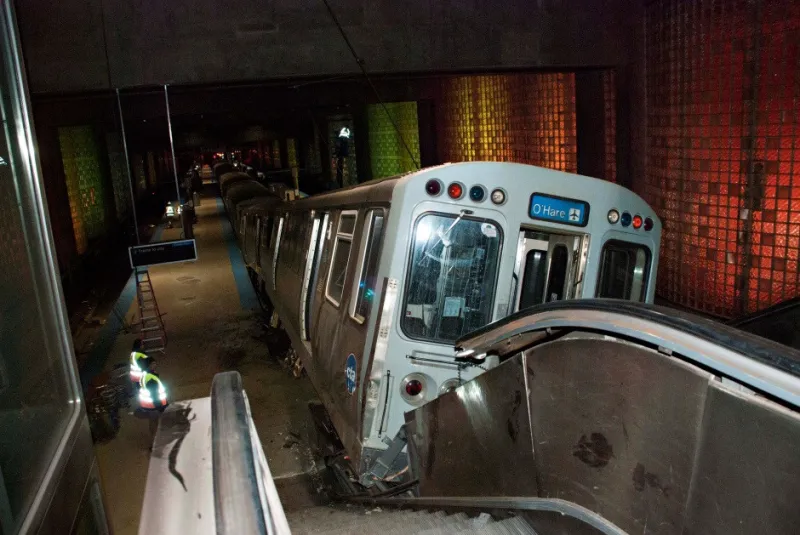
Photo: NTSB, Public domain, via Wikimedia Commons
There's a moment that happens on every crowded CTA platform in this city. Two people spot each other across the yellow line, and one of them does the thing — the small head tilt, the half-smile, the hey, it's you nod. No words. No handshake. Just recognition.
If you've lived in Chicago long enough, you know exactly what I'm talking about. And if you have one of those nod-people yourself, you also know something the rest of the world finds baffling: this stranger, this person you met standing on a swaying train car, might know you better than half your wedding guests.
The Etiquette Nobody Wrote Down
Transit friendships run on a rulebook that exists nowhere and everywhere. You don't ask what someone does for a job — not right away, maybe not ever. You don't push when they skip a day. You learn the rhythm of each other's lives in fragments: the semester they were studying for finals, the month their dad was sick, the stretch when they switched to the bus because money was tight.
"We commuted together for two years before I knew her last name," says Dana, a regular on the Red Line from Rogers Park to the Loop. "I knew she hated the heat, that her son was applying to colleges, that she made a killer jambalaya. The name felt like a technicality."
The unspoken rules are surprisingly strict. There's the seat rule — you can save a spot with your bag, but only for your person, and only if the car isn't packed. There's the delay rule: a service alert is a legitimate excuse, no apology needed. And there's the escalation rule, the big one. Sharing a phone number is a milestone. It means you've crossed from train people to actual people.
When the Train Becomes the Village
Here's where it stops being cute and starts being profound. Ask around and the stories come fast. A woman on the Brown Line who lent a fellow regular $200 when his wallet was stolen downtown — he paid her back in cash, in exact bills, three weeks later, like they'd planned it. Two men who met on the Blue Line to O'Hare and ended up going to each other's mothers' funerals. A group of Red Line regulars who now have a group text, a fantasy football league, and a standing December dinner in Pilsen.
"My emergency contact is a woman I met on a delayed train," laughs Marcus, who rides the Brown Line from Albany Park. "My sister found out and was offended for like a month. But think about it — this person literally sees me every day. She'd know if something was wrong. My college friends wouldn't notice for a week."
There's a sociology term for what's happening: weak ties, the casual acquaintances who research consistently shows boost our sense of belonging, sometimes more than our closest relationships. But standing on the platform at Belmont at 7:40 a.m., it doesn't feel like sociology. It feels like the city working the way it's supposed to.
The Delayed Train Confession Economy
Every regular knows the special alchemy of a stopped train. When the conductor announces a wait and the car goes still, something loosens. People who've exchanged nothing but nods for months will suddenly talk — really talk.
"Trains are one of the last places where you're stuck," says a Blue Line rider who asked to go by T. "Nobody's going anywhere. There's no exit to make. So when somebody says 'you okay?' and actually means it, you answer honestly. I've had two of the best conversations of my life between Fullerton and Belmont, going absolutely nowhere."
The delayed Brown Line has a reputation. Regulars swap stories like folklore — the stranger who talked a man out of quitting his job mid-ride, the impromptu birthday celebration for a conductor, the car full of people who exchanged numbers during a two-hour standby and still meet for drinks in Logan Square years later.
Why It Works Here
Plenty of cities have trains. Not every city has this. Part of it is exposure — Chicago's long commutes mean you see the same faces daily, sometimes for years. Part of it is the city's deep-rooted instinct to talk to strangers, the same one that fuels hardware store friendships and porch culture and every block party on this site.
But mostly, it's this: a commute is a shared vulnerability. You're all tired, all cold in January, all wedged into the same metal car hoping the tracks clear. There's no pretense to maintain at 6 a.m. on a Red Line car. What's left when the pretense is gone is just people — and people, given enough mornings together, will always find each other.
So the next time you catch yourself looking for your nod-person on the platform, lean into it. Say the name you finally learned. Ask about the jambalaya. The train's just the excuse. The belonging is the destination.
Are you a regular with a transit friendship story? The CTA is full of them — and honestly, we'd love to hear yours.