Sudz, Spin, and Small Talk: The Chicago Laundromats That Run on Neighborhood Memory
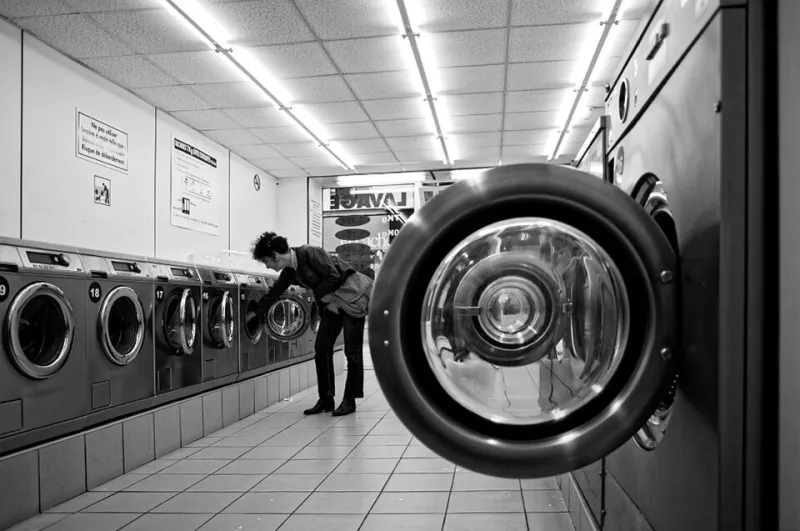
Photo: madras91, CC BY 2.0, via Wikimedia Commons
Nobody moves to Chicago for the laundromat. You move for the rent, the job, the person, the stubborn idea that this is a city you could belong to. And then one Sunday you're standing in a fluorescent-lit room on West Lawrence with a basket of wet towels, and a woman you've never met asks if you want the good dryer — the one in the corner that actually gets hot — because she's about to leave and she hates to see a neighbor waste a dollar.
That's the pitch, honestly. Not the detergent pods. The room.
The 8 A.M. Crowd Knows Each Other
There's a wash-and-fold on the North Side, half a block from the El, where the same twelve people show up Sunday morning within the same forty-minute window. Nobody organized this. It's just that the laundry has to get done, and Sunday morning is the only time in the week when it doesn't feel like a punishment. Over two years, those twelve people have learned each other's machine preferences, the names of each other's kids, and who is going to complain about the puddle by the soap dispenser.
The attendant — who has worked there since before any of them moved to the neighborhood — knows which face gets the gentle cycle and which one is going to try to jam nine pounds of bedding into a front-loader. She doesn't say much. She says good morning. She says that one's out of order. She tells you your load has eight minutes left, even though the countdown is on the machine and you can read it yourself, because that's what people say to each other in this room.
That small bit of narration is more social glue than most neighborhood associations manage in a year.
Why an Errand Beats a Happy Hour
Laundromats have one enormous advantage over every social venue the city offers: nobody has to audition for them. There's no cover charge, no host stand, no expectation that you be interesting. You carry in a bag of dirty clothes and you're already a member.
And you come back. That's the whole engine. Belonging doesn't get built in a single brilliant night out; it gets built by repetition in a place where the stakes are near zero. The laundromat is a low-cost, low-risk, high-frequency room, and Chicago has thousands of them, tucked beside taquerias and currency exchanges and corner stores, absorbing the exact kind of casual, repeated contact that turns a stranger into a person whose coat you'd recognize anywhere.
In Pilsen and Little Village, that means three generations of families cycling through the same Saturday slots, kids doing homework on the folding tables while someone's abuela re-folds the same load twice because it's a good excuse to stay and talk. In Rogers Park, it means a 24-hour room where the overnight crowd — shift workers, gig drivers, insomniacs — overlaps with the morning crowd for a strange, quiet hour around dawn. In Bronzeville, it means an attendant who will politely tell you that you left your whites in the washer, and then hold them behind the counter for you until Thursday.
The Folding Table Is a Desk, a Café, and a Complaint Department
Show up at the right hour and you'll see it. Advice is dispensed. Landlords are discussed. A debate about whether to salt the sidewalk or shovel first breaks out and gets resolved. Someone's getting a birthday card signed. Someone else is asking, genuinely, for a plumber recommendation and receiving three, one of which is a cousin and two of which are real.
This year, a handful of these rooms have started doing more on purpose — bulletin boards for block club flyers, a small shelf of abandoned paperbacks, a snack table by the change machine. Nothing formal. The infrastructure isn't the point. The point is that the room already had the traffic, and someone finally thought to leave a chair out.
Short Field Guide: How to Become a Regular Without Becoming a Menace
- Pick one place and stay loyal. Two laundromats is one too many. The whole mechanism depends on the same faces in the same room.
- Bring a dollar in singles. Tipping the attendant a buck isn't charity, it's the cheapest social investment in the city.
- Don't claim the whole bank of machines on a Sunday. Take the two you need. Leave room.
- Ask before you touch someone else's basket. Always. Even when it's clearly blocking your dryer.
- Learn names. Three, in the first month. Start with the attendant.
- Answer when asked. You don't have to initiate the conversation, but refusing to participate is the one move that flattens the room.
- Keep opinions on other people's kids, dogs, and landladies to a minimum until at least your third month.
- Play by local rules. Some rooms are silent rooms. Read the room before you run your mouth.
- Don't save seats. Especially the good folding table by the window.
- Post something. A flyer, a lost glove, anything. The bulletin board is the neighborhood's slowest and most reliable group chat.
What You Actually Take Home
You leave with clean socks, and that's fine. But the reason people keep driving past two closer laundromats to go to one specific room is not the spin speed. It's the eight minutes of conversation in front of the dryer, the attendant who noticed your new haircut, the neighbor who tells you the block's Halloween plans before anyone thinks to put up a flyer.
Chicago is a city of small rooms, and belonging usually arrives through the back door — while you're busy doing something else. Dirty laundry is as good a door as any.