Nod Recognition: The Silent Chicago Rituals That Slowly Turn Strangers Into People You'd Miss
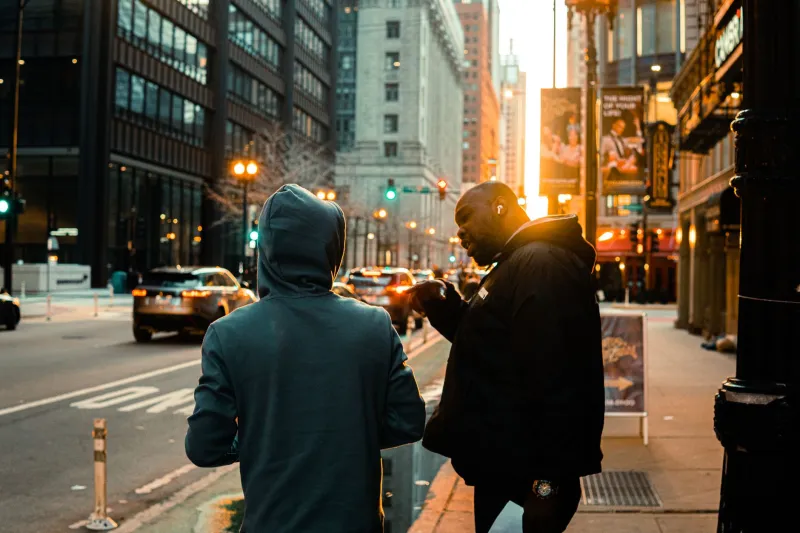
There's a man I've been nodding to for three years. I don't know his name. I don't know what he does for a living. I know he walks a black-and-white mutt down California Avenue at roughly 7:40 every morning, and I know that when our eyes meet, we do the thing — the small upward chin tilt, the universal Chicago signal for I see you, we're good, carry on.
Last Tuesday, he broke the code. "Cold one coming, huh?" he said.
I nearly dropped my coffee. Three years of silent diplomacy, undone by weather talk. And honestly? It felt like a promotion.
The Choreography of the Nod
If you've lived here long enough, you know the repertoire. There's the jogger nod — brisk, efficient, delivered mid-stride. There's the crossing guard wave, full-handed and warm, reserved for the people in neon vests who protect our kids. There's the barista recognition, a half-second of sustained eye contact that says you already know my order, let's not pretend otherwise. And then there's the chin tilt, the flagship gesture, deployed on sidewalks, at bus stops, and in the elevators of two-flats all over this city.
None of these count as conversation. That's the point. They're low-stakes by design — acknowledgment without obligation, recognition without the risk of rejection.
But here's what's interesting: those tiny rituals aren't the opposite of friendship. According to researchers who study urban sociability, they're the on-ramp.
Why Repeated Recognition Works
Sociologists have a name for the people we recognize but don't know: familiar strangers. The term dates back to the 1970s, when a researcher studying Chicago-area commuters noticed that people who saw the same faces every day reported feeling safer, calmer, and more attached to their neighborhoods — even without exchanging a single word.
The mechanism is simple. Every repeated, low-stakes interaction sends a small signal: you are predictable, you are safe, you are part of the landscape I call mine. Stack enough of those signals and something shifts. The stranger becomes a fixture. The fixture becomes a person. And one day, when the moment is right — a delayed train, a snowstorm, a dog doing something ridiculous — the conversation happens almost automatically, because the groundwork was already laid.
Psychologists sometimes call these weak ties, and the research on them is startling. People with more weak-tie connections report higher levels of belonging and even better mental health than those who rely solely on a tight inner circle. In a city of 2.7 million, the nod might be the most scalable form of community we have.
When the Silence Breaks
I started asking around, and once you bring it up, everyone has a story.
There's Dana, a nurse from Jefferson Park, who nodded at the same man at the CTA platform for four years before a red-eye home from a family funeral put them on the same 5 a.m. train. "He asked how I was doing, and I just — told him. Actually told him. We've been getting coffee after shift ever since. His name is Ray. Four years, and I didn't know his name was Ray."
There's Marcus in Pilsen, who spent two summers waving at the same crossing guard on 18th Street. When he got laid off last spring, she was the first person he told. "She'd been waving at me for two years. Felt like she deserved to know why I was suddenly walking around at 10 a.m. on a Wednesday." She connected him to a job lead within a week.
And there's the legendary case of the Bridgeport dog people — two owners whose pets were convinced they were best friends, forcing the humans into a nodding acquaintance that graduated to a shared walking route, then a standing Saturday coffee, then attendance at each other's kids' birthday parties. The dogs never spoke. They didn't have to.
A Field Guide to Escalation
If you've got a familiar stranger of your own and you're wondering how to make the leap, the good news is that Chicago has already engineered the perfect excuses:
- Weather. The official language of the city. "Brutal one today" has opened more friendships than any dating app.
- The dog loophole. Asking about someone's dog is legally binding in most neighborhoods. Follow-up questions are expected.
- Shared infrastructure. The same bus, the same platform, the same el stop. "This line is never on time" is a handshake in transit form.
- Seasonal milestones. First snowfall, first 80-degree day, the day the patio furniture comes out. These are communal events, and commenting on them is participation.
The rule, if there is one, is to keep the first exchange small. You're not asking for their life story — you're confirming what the nod already established: we're on the same side.
The Belonging Blueprint
Here's what I've come to believe after three years and one weather comment on California Avenue: belonging in a big city doesn't arrive as a single big event. It compounds. A nod becomes a wave. A wave becomes a name. A name becomes a coffee. A coffee becomes the person who notices when you're not there.
The city works because millions of us keep performing these tiny acts of recognition, morning after morning, mostly without thinking about it. So the next time you catch eyes with your familiar stranger — the jogger, the guard, the guy with the black-and-white mutt — hold the nod a half-second longer. Say the thing about the weather.
You might be one cold front away from a friend.